
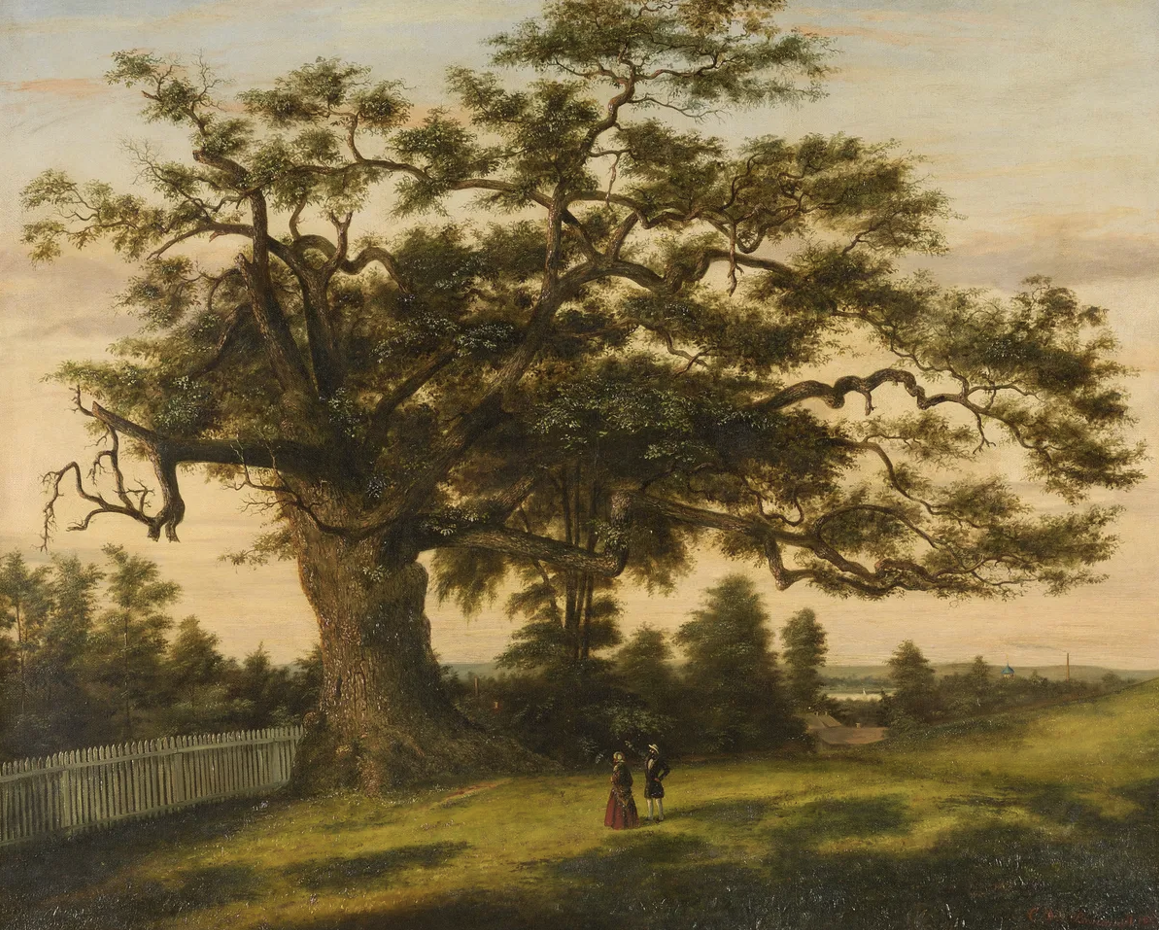
The Charter Oak — a Connecticut symbol often associated with self-government and liberty.
Our Connecticut Roots
Connecticut has a long tradition of self-government. In 1662, King Charles II granted the Connecticut Colony a charter that affirmed broad local authority. In 1687, Governor Edmund Andros attempted to seize that charter during a political crackdown aimed at consolidating colonial control.
The best-known version of what happened next is the Charter Oak story: according to tradition, the charter was hidden to prevent its confiscation. Historians generally treat the “hidden in an oak tree” detail as part of Connecticut’s civic legend—powerful as a symbol, but not something we present as a proven fact.
The oak itself later became a statewide icon. It reportedly fell in a storm in 1856, and the wood was preserved in commemorative items—helping cement the Charter Oak as a symbol of Connecticut’s independent spirit.
Modern Libertarianism
Libertarianism is built around a simple idea: people should be free to live their lives in peace, and government power should be limited to protecting rights—not managing daily life. The national Libertarian Party was founded in 1971 as part of the modern libertarian movement in American politics.
In Connecticut, those principles show up in practical terms: defending civil liberties and due process, lowering the cost of living by cutting red tape and special-interest carve-outs, protecting property rights, and demanding transparency and accountability from Hartford.
Why This Matters in Connecticut
Connecticut’s political system makes it hard for new parties to compete without serious grassroots effort. Ballot access and party status are governed by state rules and petition processes that reward entrenched major parties.
That’s why we focus on building from the ground up: clear goals, credible candidates, local organizing, and an honest, common-sense message that reaches voters who are tired of partisan theater.
Our mission
Build a freer, more affordable, and more accountable Connecticut—by protecting civil liberties, lowering costs, and holding government to its proper role.
Sources & Notes
- Charter Oak background and the distinction between legend and documented history: Connecticut Humanities
- Charter Oak summary and civic significance: Connecticut Judicial Branch / State historical materials
- Major party definition in Connecticut election law (CGS §9-372): Connecticut General Statutes
- Nominating petitions and party status overview: Connecticut Secretary of the State